
The West Virginia Statewide Case Search
WVPASS, the West Virginia Public Access to State Court Proceedings site, is the public search route the Judiciary links for Circuit Court records. It launched March 10, 2025. Coverage spans public Circuit records from all 55 counties, reaching back to 1999. Registration and searching cost nothing. Public document downloads run $0.25 per page plus a nominal card fee, though attorneys of record download documents in their own cases without charge. Sealed and juvenile filings are excluded. Keep in mind these limits describe public Circuit records only, not every record type held by every West Virginia court.
Start at the West Virginia Judiciary's Court Records Access page, which links WVPASS for Circuit matters and MCR for Magistrate matters. WVPASS describes its own scope and access terms once you open it, so treat any field list you see elsewhere as unconfirmed until the portal itself displays it.
- Identify whether the case is a Circuit, Magistrate, Family, municipal, probate, or appellate matter. WVPASS is for public Circuit records.
- Open WVPASS from the Judiciary’s Court Records Access page. Use only fields and instructions actually displayed; no field names or filters were verified in the research browser.
- Search or register without charge. If the record is within public scope, review the case information and any document links the portal makes available.
- Account for the $0.25-per-page charge plus a nominal card fee for public document downloads. Search itself is free.
- If the matter is Magistrate, use MCR for case information. If a full docket or missing document is needed, contact the clerk who holds the county file.
| Portal / Search Field | Verified Path | Unknown or Limits |
|---|---|---|
| WVPASS | Public Circuit records from all 55 counties, reaching back to 1999; free search and registration. | Search-field labels, required entries, dropdowns, result limits, sort, pagination, and refresh controls were not verified. |
| MCR first name | The Judiciary’s instructions describe a first-name search for Magistrate case information. | Required status and live form behavior; the search flow stopped at CAPTCHA during research. |
| MCR last name | The Judiciary’s instructions describe a last-name search for Magistrate case information. | Required status, matching rules, and any optional filters were not verified. |
| MCR case number | The official guide permits a case-number search; MCR returns no document images and is limited to 30 results. | A universal lower-court number format and the live form’s exact controls were not verified. |
The official West Virginia WVPASS portal is the source for public Circuit docket search access. The page presents its own search controls, so rely on what it displays rather than any secondhand description of its fields.
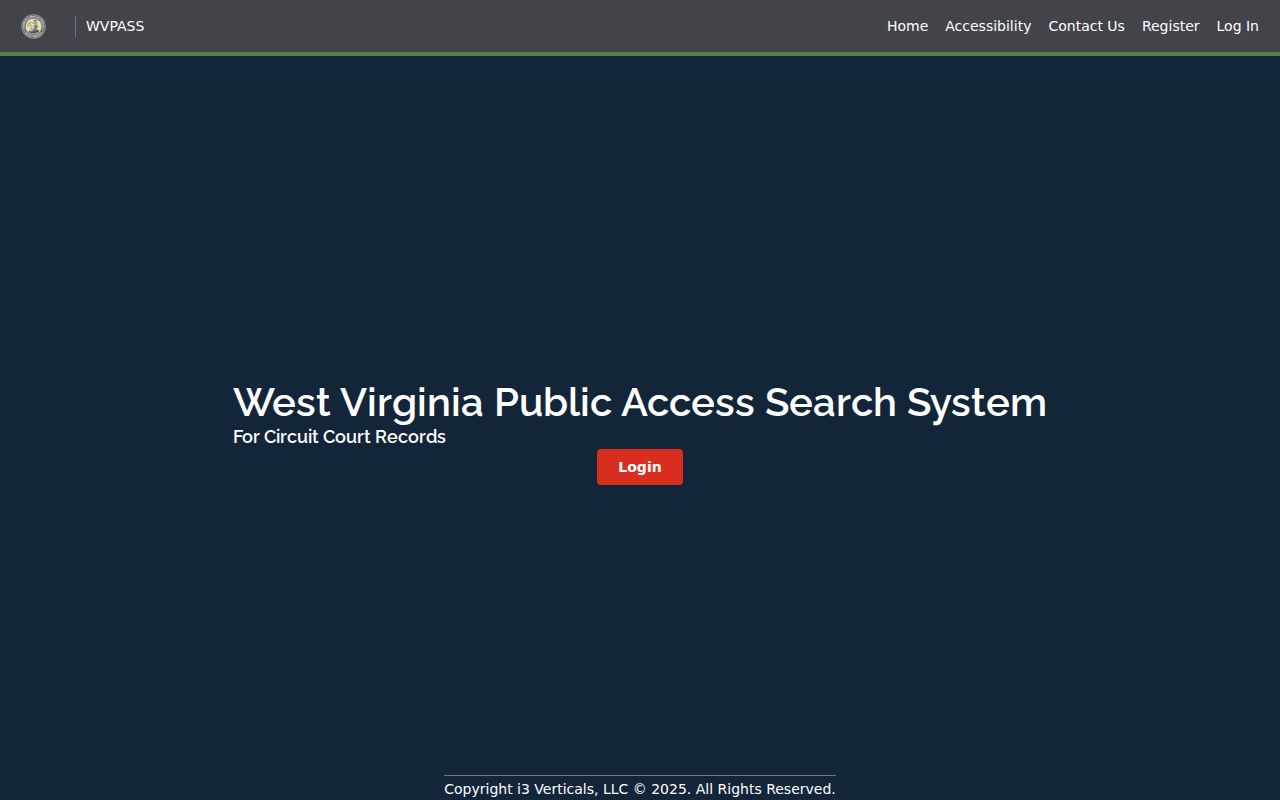
Use West Virginia's documented coverage and fee details, and treat any unavailable control as unknown until the portal itself displays it.
Note: Published West Virginia portal coverage does not confirm that a particular case or document image is available today.
West Virginia Case Search Fields Remain Unverified
WVPASS covers a lot, but read its reach with care. The portal describes public Circuit Court materials from every county, reaching back to 1999. Sealed and juvenile filings stay out. Family Court pleadings and exhibits follow their own confidentiality rules. It is not a Magistrate, Municipal, probate, or appellate search either. Coverage also depends on record type and access status. The Judiciary publishes no list of counties that opt out.
What about the search fields themselves? The WVPASS portal does not present a stable search form. So no individual docket could be opened, and its controls remain unverified. Field labels, county or court filters, sort order, export options, result caps, pagination, and mobile behavior are all unconfirmed. Do not assume exact-name matching, wildcard support, or real-time updates. The Judiciary's WVPASS launch announcement spells out public scope and access terms. It is not a field-by-field guide.
When a West Virginia search interface stalls, go through the Judiciary access page. Do the same when a result looks uncertain. Pick the right portal there. Then call the clerk who holds the county record. The published scope of WVPASS guarantees neither a working control nor that any specific case or document is available right now.
Searching by Case Number
A West Virginia case number identifies a matter filed in a particular court. The judiciary defines a docket number as the designation assigned to a case. It is also called its case number. There is no complete statewide glossary of lower-court number patterns. Formats may differ by court and county. Use the number printed on a notice, citation, or prior order. Do not reconstruct it from a generic pattern.
The West Virginia Magistrate Payment System shows example case identifiers such as ##-M##X-##### and M##M-##########. These come from an ID-based payment tool, not a universal case-number grammar or a complete list. That payment search requires a citation, case, or payment-plan ID. It is not a person-name or license-plate search. It does not replace MCR or WVPASS. If your number is incomplete, ask the clerk to confirm it and identify the right court.
One more wrinkle deserves mention. A West Virginia felony can have a Magistrate docket for preliminary proceedings. It may carry a later Circuit docket after bindover. An appeal creates yet another docket number. That one lands at the Intermediate Court of Appeals or Supreme Court of Appeals. Search each court level tied to the case rather than treating one number as the whole history.
West Virginia Magistrate Case Search Uses MCR
West Virginia's Magistrate Case Record Search, or MCR, is separate from WVPASS. The official instructions say it searches statewide Magistrate case information. You can search by first name, last name, or case number. It is free, requires no registration, and limits results to 30. MCR does not provide document images. Its public notice warns that results may be incomplete or inaccurate. So have a clerk confirm a result or a missing case.
The West Virginia Judiciary's MCR search guidance describes the search paths. The live MCR entry page presents a CAPTCHA check before results load. Exact controls and matching behavior remain unknown.
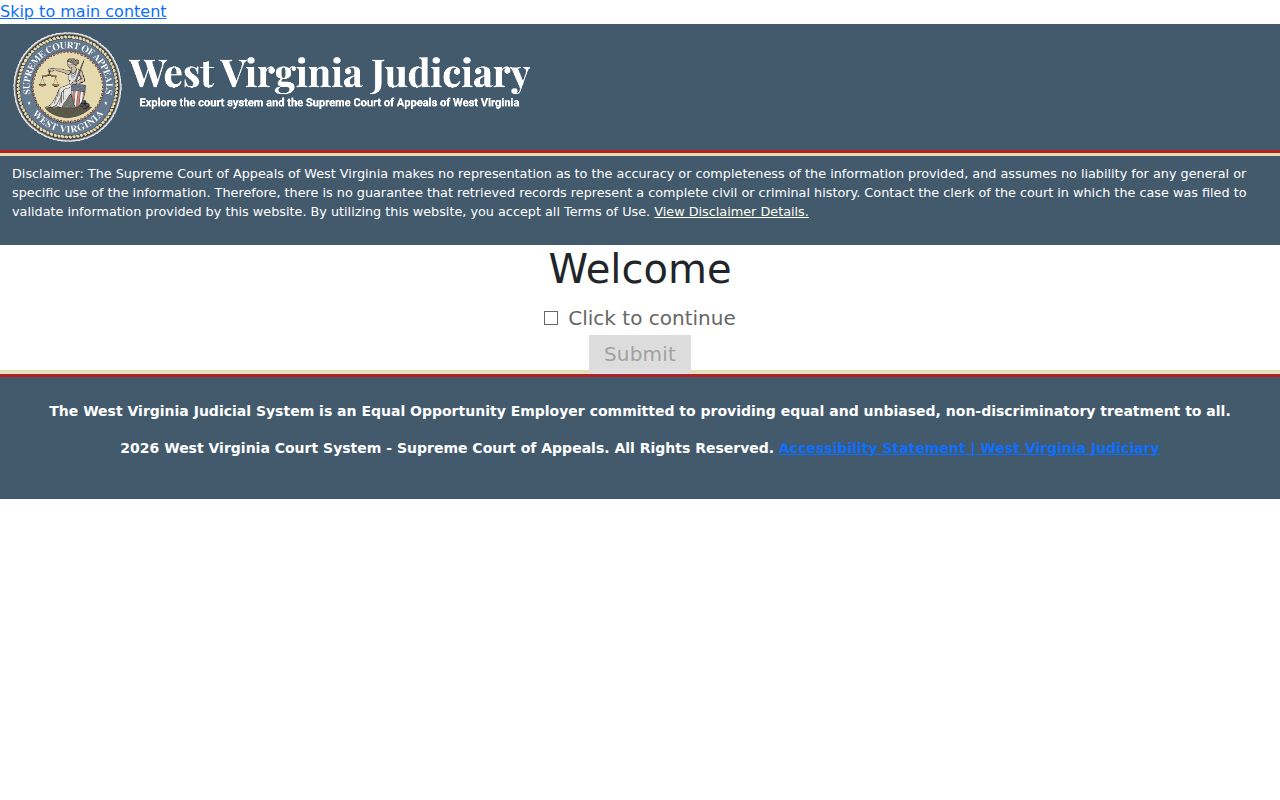
What you see at the MCR gate is an access screen. It is not a successful query, and it is not an individual record. No private case gets opened there. When a West Virginia query comes back blocked, call the local Magistrate Court Clerk. Do the same when the result list fails to answer the question. Ask for the case information or the document itself.
Clerk arrangements differ across West Virginia. Some counties employ a separate Magistrate Court Clerk; elsewhere Circuit Clerk staff handle the work. The county court directory shows the local contact. Keep in mind that an MCR result is only an index entry. It is not the official document file.
Note: MCR's 30-result limit does not promise that a search found every matching West Virginia Magistrate case.
West Virginia Case Number Patterns Vary
A case number can cut through confusion when names are common. But a number only makes sense with its court and its county attached. West Virginia has never published one complete lower-court format or code list. So treat the letter or digit blocks in an unfamiliar number as a clue. It is not a guaranteed case type until you check the record source.
Copy the full case number exactly as it appears on the notice or the clerk record. Include punctuation and leading characters. Payment-system examples are not a glossary. A Magistrate number may not identify a later Circuit prosecution or appeal. When a number returns nothing, verify the court level first. Then ask the clerk whether the number changed or a separate docket was opened.
What a Case Search Returns
West Virginia search results are not the same thing as a complete docket. WVPASS opens public Circuit records within its published scope. The exact result labels can vary. The case-detail layout can vary too. The West Virginia MCR blank case-detail template shows the kinds of fields that may appear for a Magistrate matter. Treat the schema as a template only. It is not a populated sample case, and not every field appears in every record.
| Case ID and Location | Blank MCR template labels for a case identifier and the associated court location. |
|---|---|
| Case Description and Type | Template fields describing the matter and its category; fields may vary by case. |
| Filing and Appearance Dates | Template date labels for filing and expected appearance, when available. |
| Parties and Charges | Template sections for case parties and charges; they do not establish a final outcome. |
| Case Event Schedule | Template schedule fields include event type, date and time, room, location, judge, and reason closed. |
| Docket Entry | A section label for recorded activity; a full document or signed order may need to be requested separately. |
| Documents | MCR does not provide document images. WVPASS document availability depends on public scope and its live record access. |
A short label does not tell you the outcome. Nor does every West Virginia search portal display the same fields. For a Magistrate entry that reads unclearly, ask the clerk for the underlying order. For Circuit cases, go to the county Circuit Clerk whenever the public index is incomplete. Go there if a document is unavailable. Go there too if you need an authenticated copy.
West Virginia CourtPLUS Filing, Not Case Search
In West Virginia, Circuit and Family Court filings move through CourtPLUS and WV E-File. WVPASS is the public Circuit search route. CourtPLUS is case management for court staff. WV E-File serves attorneys and other authorized users. The Vault stores digital case materials. Together these systems keep filings and court operations running. But the registered-user filing interface is not a public case-search portal.
The West Virginia Judiciary’s CourtPLUS and e-filing overview explains the authorized filing path. E-filing went live statewide in all 55 counties by July 15, 2024. Self-represented litigants submit paper filings to the Circuit Clerk. The clerk scans or enters them into the file. The filing receipt confirms completion. An uploaded draft alone does not. The public docket and the filing workspace serve different users with different access limits.
For a broader account of how county case files connect to statewide systems, see the West Virginia Court System page. For a particular West Virginia case, the county Circuit Clerk remains the route to the full local file, the public terminal, a certified copy, or any record that is not online.
Note: Authorized filing access and public case search have different purposes. They follow separate West Virginia access rules.
Statewide vs County Case Search
In West Virginia, start with the statewide portal that matches the court tier. Then contact the local clerk for the complete file. WVPASS searches public Circuit records across all counties within its stated date and access scope. MCR searches Magistrate case information but does not show filed documents. The Circuit Clerk holds Circuit and Family files. The Magistrate Court Clerk holds Magistrate records. Start at the West Virginia county directory to identify the county route. Use the official Judiciary directory for current court contacts.
| Record Route | What It Provides | Where to Go Next |
|---|---|---|
| WVPASS | Public Circuit records from all 55 counties back to 1999; sealed and juvenile filings excluded. Search and registration are free; public downloads have a per-page charge. | Ask the Circuit Clerk for the complete local, older, missing, or certified record. |
| MCR | Magistrate case information by first name, last name, or case number; 30-result limit, no document images, and an accuracy/completeness warning. | Contact the Magistrate Court Clerk for documents or confirmation. |
| County Circuit Clerk | Custodian for Circuit and Family case files, public terminal access, paper records, and certified copies, subject to confidentiality rules. | Use the county directory and Judiciary court-contact listing to reach the correct office. |
| Municipal or probate file | Municipal ordinance records and County Commission probate records are separate from WVPASS. | Contact the municipality or County Commission Clerk/Fiduciary Supervisor that holds the record. |
In West Virginia, “statewide” describes a portal’s reach, not a promise of one complete record for every court. The local docket sheet and certified copies stay with the clerk. Appellate, federal, municipal, probate, and restricted Family Court records follow separate routes.
West Virginia Case Search With No Result
A West Virginia case search that comes back empty can mean several things. The court tier may be wrong. The record may fall outside a portal's scope. Access may be restricted, or the online docket entry may simply be unfinished. MCR itself cautions that results can be incomplete or inaccurate. WVPASS publishes its Circuit-record scope. It offers no public refresh schedule or field descriptions. One point matters most: a blank screen is not proof that no case exists.
Narrow it down instead. Check the citation, notice, or prior filing for the county and court. For a Circuit case, ask the Circuit Clerk to search the local record, the public terminal, older files, and the copy route for documents. For a Magistrate matter, take it to the Magistrate Court Clerk. Bring the case number if you have it. Add the party name, rough filing period, and record type. Felonies and appeals may carry a second docket at another court level. One clean search is rarely the whole story.
Note: A no-result screen does not confirm that a West Virginia case never existed or was never filed. It is not that kind of proof.
West Virginia Case Search by Court Level
No single search covers every West Virginia court. Circuit cases live in WVPASS. Magistrate metadata sits in MCR. Municipal ordinance matters stay with the municipality. Probate belongs to the County Commission record custodian. Federal cases run on federal access systems, not the state portals. The court type tells you where the authoritative docket lives.
The appellate side has its own limited tools. The SCA and ICA docket pages list scheduled arguments and calendar entries. They are not a complete search of all appeals. They cannot replace county trial calendars. The Judiciary calls a full appellate case search a work in progress. So treat an argument listing as just that. The West Virginia Business Court locator carries a similar warning on its own page: the listed cases are not exhaustive. Confirm any case and its orders with the clerk.
A case that moved between court levels may leave traces in more than one place. The Circuit record might show only a notice of appeal. The appeal itself runs under a separate ICA or SCA number. Search each docket on its own. If a portal does not match the court type, stop. Go through the county or the court clerk instead.
Access and Restricted Cases
West Virginia court records are open to inspection by default under West Virginia Code §51-4-2. Statutes, court rules, and orders can still restrict access. Open courts do not mean open files. WVPASS leaves out sealed and juvenile filings. Juvenile records are generally confidential under West Virginia Code §49-5-103. Family Court works in layers too. Orders and indices may be public, yet pleadings and exhibits stay confidential under Family Court Rule 6. So a docket search may surface only a thin public entry. Or nothing at all, for a restricted matter.
Circuit filings can be sealed by court order under Trial Court Rule 10.03 and Rule 15A. Filers must redact certain personal identifiers under Rule 15A.24. These controls shape what an online search shows. They also shape what a clerk may hand a member of the public. Expunged records vanish from public view under the governing order and statute.
Never try to work around an access limit if a record is missing. Ask the clerk which public records or orders exist and which rule applies. Protected materials require the legal authority or court order set for that record. A search result alone never establishes eligibility. The custodian can also tell you whether a public order or index is open for inspection. The file behind it may stay confidential.
Access depends on the record type.
West Virginia’s WVPASS is a public Circuit index and document route within its scope. MCR is a Magistrate case-information index without document images. Family, juvenile, sealed, and expunged records have separate limits. The relevant clerk can identify the public portion and the proper request route.
Note: The record custodian can explain which West Virginia public entry is available and which access rule applies.