
The West Virginia Court System
At the top sits the Supreme Court of Appeals of West Virginia (SCA). It is five justices strong. Below it, the Intermediate Court of Appeals (ICA) takes the appeals assigned to it. Circuit Courts hold general jurisdiction. Family Court handles domestic relations. Magistrate Court hears misdemeanors, felony preliminary proceedings, and limited civil matters. Two clerk offices divide the paperwork. Circuit Clerks keep the Circuit and Family files, while Magistrate Court Clerks keep Magistrate records.
Municipal Court sit outside the unified structure and enforce local ordinances. The County Commission handles probate. Federal cases run through separate federal courts and PACER. One matter can also pick up separate dockets as it moves through its stages. The Magistrate, Circuit, and appellate dockets each track one stage.
| Court or office | Role in West Virginia | Record keeper or access route |
|---|---|---|
| SCA | Highest state court; hears assigned appeals and petitions from the ICA. | Office of the Clerk of the Supreme Court of Appeals. |
| ICA | Intermediate appeals, generally in specified civil, family, and administrative categories. | Office of the Clerk of the Supreme Court of Appeals. |
| Circuit Court | General trial jurisdiction, felony matters, and specified appeals. | Local Circuit Clerk; public Circuit access also through WVPASS. |
| Family Court | Domestic relations and final civil domestic-violence proceedings. | Circuit Clerk, subject to special file-confidentiality rules. |
| Magistrate Court | Misdemeanors, felony preliminary proceedings, and limited civil claims. | Magistrate Court Clerk function; MCR shows case information. |
| Municipal Court / County Commission | Municipal ordinance matters / probate and fiduciary matters. | Municipal office / County Commission Clerk or Fiduciary Supervisor. |
| Federal District Courts | Separate Northern and Southern Districts and federal proceedings. | Federal Clerks; PACER and CM/ECF. |
West Virginia's Circuit Court Docket Map
The state divides into 30 judicial circuits covering 55 counties. It reports 80 Circuit Court judges for 2025. A circuit can group one to four counties. So a county is the practical starting point for a local case file. Family Court runs on its own map of 27 circuits and 48 judges. These counts describe how courts are organized, not what any portal covers.
Civil jurisdiction crosses a threshold range. Circuit Court holds original general civil jurisdiction for matters above $7,500 under W. Va. Code §51-2-2. Magistrate Court handles civil claims up to $20,000 under §50-2-1, subject to exclusions. The $7,500 to $20,000 band overlaps. Dollar value alone does not split every civil case into one court tier. Case type and statutory exceptions also matter.
Note: West Virginia court counts and judge totals are dated statewide figures. Local case assignment still depends on court jurisdiction and the filing county.
The Statewide Case Search Portal
West Virginia runs two distinct statewide public lower-court search products. There is no single portal for everything. WVPASS searches and provides public Circuit Court materials. The Magistrate Case Record Search (MCR) returns Magistrate case information instead. Pick the system that matches the court tier. Then turn to the Circuit Clerk or Magistrate Court Clerk for the underlying record. The West Virginia case-search steps walk through that choice.
| System | Public coverage | Important limit |
|---|---|---|
| WVPASS | Public Circuit Court records across all 55 counties, stated back to 1999; search is free. | Sealed and juvenile material is excluded. Public downloads are $0.25 per page plus a nominal card fee; no refresh or uptime schedule was verified. |
| MCR | Free Magistrate case information statewide; instructions describe name or case-number searches and a 30-result limit. | No filed-document images. Confirm completeness and details with the local Magistrate Court Clerk. |
| CourtPLUS / WV E-File / Vault | Circuit and Family case management, e-filing for authorized users, and digital file storage. | Operational filing and storage tools, not the public case-search portal. |
| ICA / SCA pages | Current appellate calendars and published opinions. | A comprehensive appellate case search remains under development in the latest public guidance reviewed. |
Each portal covers specific court and record types. Municipal ordinances, County Commission probate, federal cases, and confidential Family files all need other routes. WVPASS's all-county statement applies to public Circuit material within its stated range, not to every docket in West Virginia.
West Virginia Magistrate Court Records Use MCR
MCR is a free statewide search for Magistrate case information, not scanned pleadings or orders. Judiciary instructions allow searches by first name, last name, or case number. A 30-result cap applies. The site's own notice warns that results may be incomplete or inaccurate.
For an actual West Virginia filing, ask the Magistrate Court Clerk in the filing county. Copies and public-terminal access are clerk matters. A felony may first appear in Magistrate Court. Then it can receive a separate Circuit Court number after bindover. MCR shows neither that later Circuit file nor either court's document images.
How Dockets Flow From County to State
A Circuit or Family matter in West Virginia is filed in its county and maintained by the local Circuit Clerk within statewide case-management tools. Public view runs through a separate access layer, trimmed by case type, redaction, and confidentiality rules. When a public document is not online or an authenticated copy is required, the clerk still holds the record.
Circuit / Family path: County filing › Circuit Clerk case file in CourtPLUS / Vault › eligible public Circuit material in WVPASS.
Docket technology varies by court level in West Virginia. Magistrate Courts run on a separate Unified Judicial Application. The MCR side publishes case information without the underlying documents. File an appeal and a fresh docket opens at the ICA or the SCA. To pull records locally, the West Virginia county directory points you to the right clerk. The Circuit Clerk keeps Circuit docket sheets and case files. The Magistrate Court Clerk holds the Magistrate records.
The West Virginia Judiciary county court listing names each county's Circuit Court. Its clerk contacts appear there too.
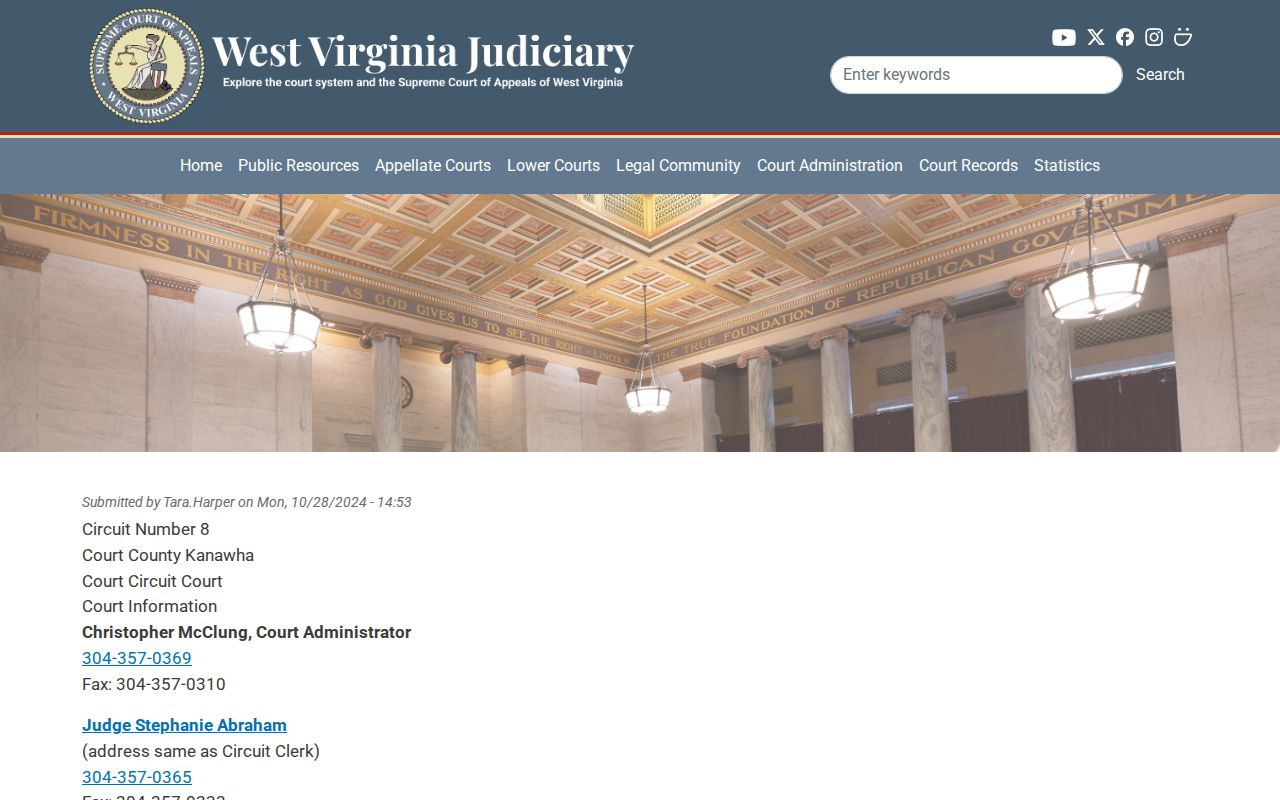
That contact listing routes a records question to the proper court office. It is not a statewide docket search form.
Note: West Virginia public access is separate from case management and does not establish real-time posting anywhere statewide.
AOC Supports West Virginia Court Records
The West Virginia Administrative Office of the Courts (AOC) is also called the Office of the Administrative Director. It supports the courts statewide. Its units cover Circuit and Family Court Services, Magistrate Court Services, technology, statistics, forms, and operational support. Reports the state publishes draw on information supplied by local court clerks. The AOC keeps court operations and reporting running. But it is not the public custodian of every county case file. The West Virginia Judiciary's AOC overview describes its units and duties.
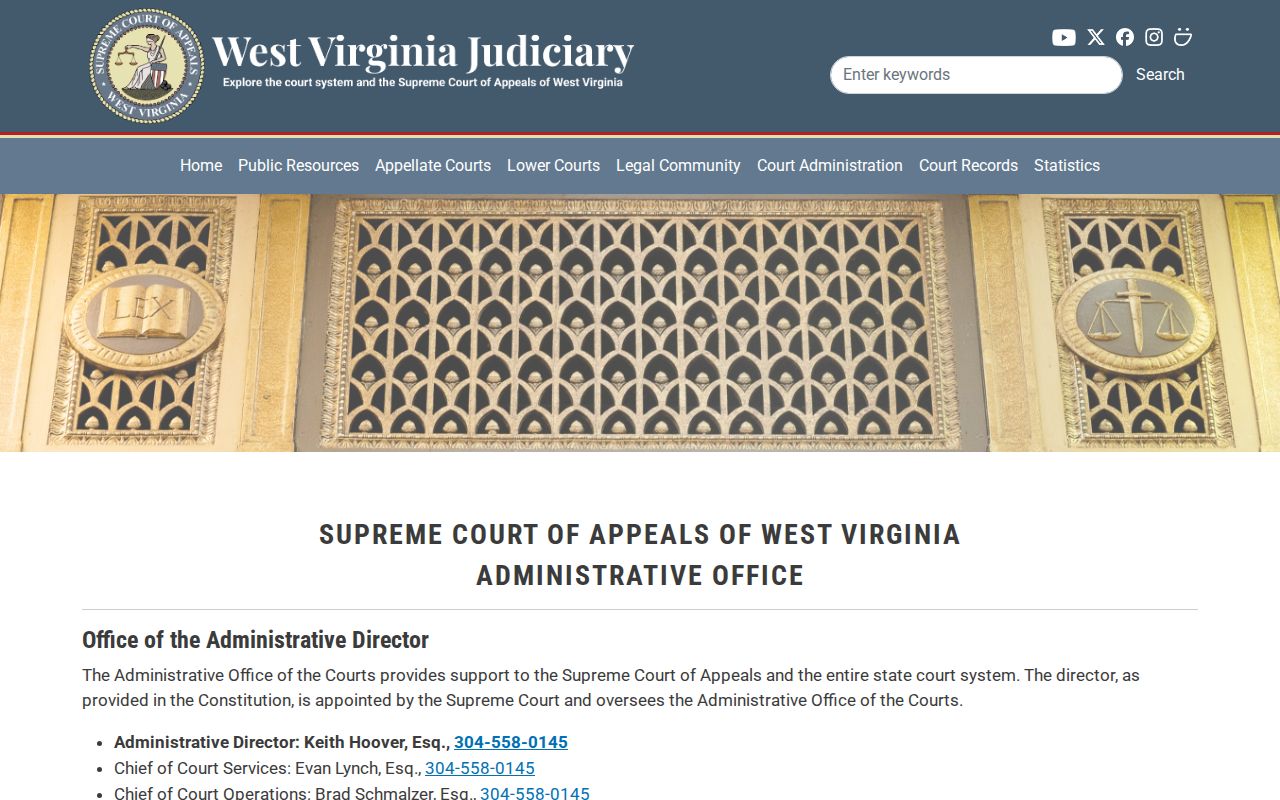
For a specific West Virginia docket, the local clerk remains the starting point. The AOC's statewide role is coordination, technology, and court administration.
CourtPLUS / WV E-File and E-Filing
CourtPLUS is the case-management system West Virginia uses for Circuit and Family cases. Vault holds the digital files. WV E-File is the filing side. It is open to attorneys, pro hac vice counsel, government users, and other authorized filers. Every one of the state's 55 counties came online by July 15, 2024. It is built for filing and court workflow, though, not for public case search. The Judiciary's Circuit and Family Court e-filing overview walks through the CourtPLUS workflow. It also spells out who may register.
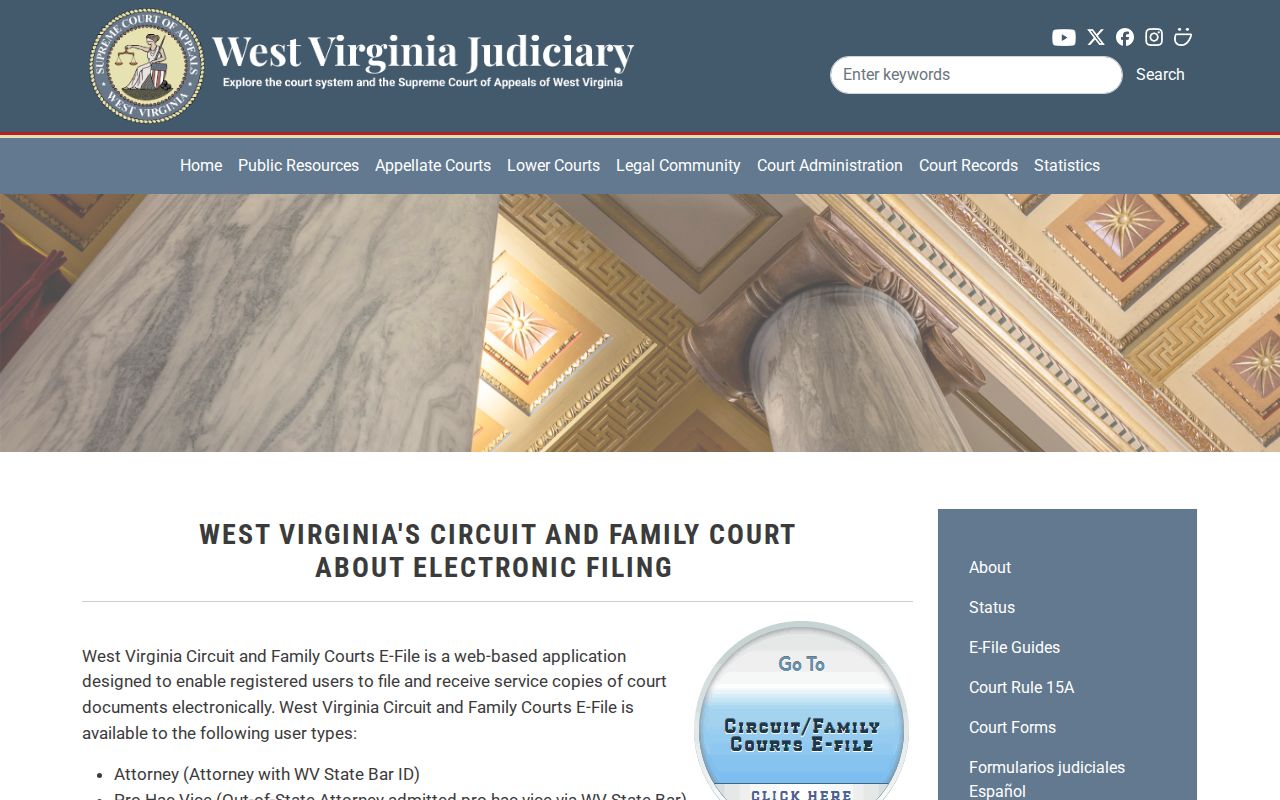
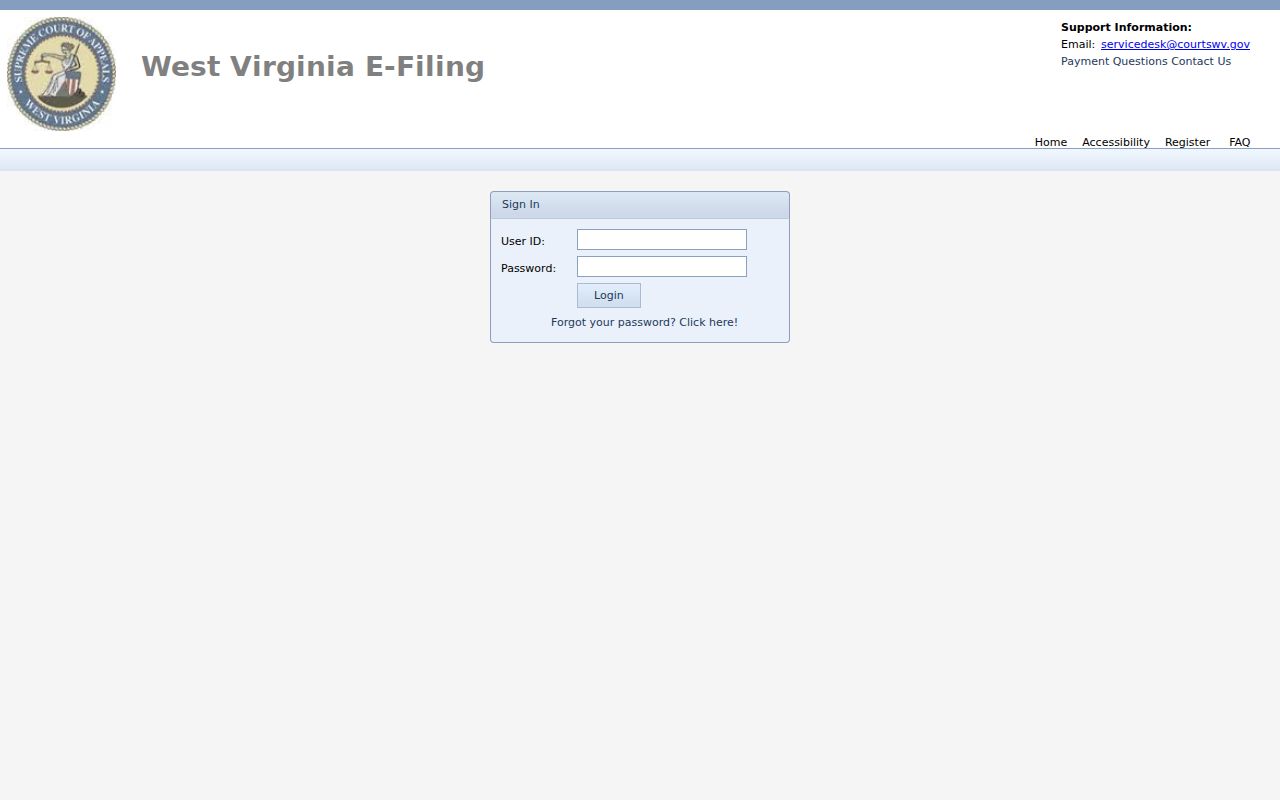
Court staff rely on these tools to move cases along and store papers. Keep one point in mind: a filing sitting in a case-management system is not automatically viewable by the public. The WV E-File sign-in exists for registered users making authorized submissions, not for browsing dockets.
Self-represented filers in West Virginia hand their paper to the Circuit Clerk. The clerk scans it into the case file. Under West Virginia Trial Court Rule 15A, the filing counts as complete when the user gets a receipt. A first uploaded draft is not enough. Filers bear the job of redacting protected identifiers before submitting anything. Rule 15A.26 also provides a public terminal for eligible Circuit files. That terminal does not open confidential Family contents or sealed papers.
West Virginia E-Filing Is Not Case Search
People often assume the login that submits a case is also the place to search an existing public docket. It is not. In West Virginia, authorized filers use WV E-File to submit Circuit or Family documents. WVPASS is the public Circuit access product, and MCR covers Magistrate case information. Each tool serves a different set of users and shows different material.
Rule 15A.26 lets the public inspect eligible electronic Circuit files at the clerk's terminal. So e-filing never makes every Vault document public. Family, sealed, and juvenile records keep their own restrictions. If a filing seems missing, ask the Circuit Clerk about it.
Quick distinction: WV E-File submits authorized filings; WVPASS searches eligible public Circuit records; the Circuit Clerk holds the county case file.
Note: An e-filing receipt only confirms submission; public access still depends on the case type and the access rules that apply.
Statewide Portal vs County Docket
WVPASS is West Virginia's statewide public access layer for Circuit Court records. The county Circuit Clerk holds the actual case file and docket. Use WVPASS to find public Circuit materials and documents within its stated scope. Anything beyond that belongs to the clerk in the county where the case was filed. That includes a missing item, an older file, a public-terminal review, or a certified copy. The West Virginia county directory points you to that office. MCR handles Magistrate case information only. It offers no document images.
| Record question | Statewide portal | County case file |
|---|---|---|
| Public Circuit coverage | WVPASS covers public Circuit material from all 55 counties, with stated records back to 1999. | The Circuit Clerk retains the local case file, including papers and older material subject to access rules. |
| Case activity | Public docket and record information within the portal's scope. | Official county docket and full case history maintained by the custodian. |
| Documents | Eligible public Circuit images may be downloaded for a per-page fee. | Clerk handles records missing online, terminal inspection, paper copies, and retrieval. |
| Authentication | A portal download is not a clerk-certified copy. | Ask the Circuit Clerk for certification and the local fee or delivery process. |
| Other court tiers | MCR supplies Magistrate metadata; appellate sites list selected calendars and opinions. | Magistrate, Family, appellate, municipal, and probate custodians apply their own access rules. |
The statewide index and the local docket answer different questions in West Virginia. A search result can help you identify a case. But a court order, a complete file, or a certified paper still has to come from the office holding the record.
West Virginia Appeals Create Separate Dockets
An appeal in West Virginia opens a separate case number and record. The trial docket may show the notice or transmission. The appellate docket carries the entries, briefs, and argument schedule. Since July 1, 2022, the ICA has generally heard specified civil, family, and administrative appeals. Criminal, juvenile, abuse-and-neglect, and other categories may go straight to the SCA. So the statutory route depends on the case type.
One appellate Clerk serves both state courts. The current docket pages list arguments, cases, and some briefs. A comprehensive appellate search is not offered. Published opinions, though, are searchable and free to read. Federal appeals travel to the Fourth Circuit through entirely separate systems.
West Virginia Court System Technology and History
The 1974 Judicial Reorganization Amendment took effect in West Virginia on January 1, 1976. It retired the old justice-of-the-peace arrangement. It set up the unified state-court structure, leaving municipal courts separate. Family Court launched on January 1, 2002. By 2016, Magistrate Court technology ran on the Unified Judicial Application. CourtPLUS / WV E-File later stretched Circuit and Family digital workflows across the counties.
More layers followed. The ICA and appellate File & ServeXpress e-filing began July 1, 2022. MCR public search was announced in January 2024. It added Magistrate case information without document images. WVPASS opened public Circuit search on March 10, 2025, with public materials stated back to 1999. Each change added access while leaving local record custody where it was.
Note: the back-to-1999 statement does not promise that every historic page or file volume has been digitized.
West Virginia's Court Docket Technology Transition
West Virginia likes to announce modernization before it arrives. Separate the promises from the systems you can actually use. In October 2025, the Supreme Court signed a contract for CourtOne, a unified case-management and e-filing platform meant to serve the lower courts. The Judiciary had not confirmed a statewide CourtOne go-live by September 24, 2026. Until it does, CourtPLUS, WVPASS, and MCR remain the documented channels for West Virginia court records.
The same caution applies to the appellate side. A Tyler e-filing and public-access product for appeals was announced in April 2025 with a late-summer target. Yet the Judiciary still describes comprehensive appellate search as under development. A target date is not proof of launch.
One change is real and running. Since July 1, 2026, the West Virginia Judiciary's active-case dashboard has displayed aggregate Circuit and Family statistics by county and by judge. It is refreshed daily at midnight. The dashboard gives caseload context, not a docket search or case-file lookup. Filing totals and active-case snapshots also measure different things, so don't read one as the other.