
West Virginia Court Calendars
A court calendar is simply the lineup of hearings a court has assigned. In West Virginia, a setting can also show up as an event on the case docket. The two records answer different questions. A docket tracks everything filed or scheduled in one case. A daily calendar groups many cases set before the same judge on the same day. So a case's own event list will not reveal the rest of that day's docket.
Circuit, Family, and Magistrate settings are managed court by court and county by county. A West Virginia statewide case search can help you find a public case record. But it is not a statewide trial calendar. A date may surface in the case docket. It may also appear in a local notice, or a clerk's case-management view. When the online entry is unclear, call the court office to confirm any change. The right route depends on which West Virginia court holds the case.
West Virginia Has No Statewide Trial-Calendar Search
West Virginia offers no statewide public search for lower-court trial calendars or daily dockets. WVPASS covers public Circuit Court records. However, it does not provide a date-based trial calendar. The Magistrate Case Record Search, or MCR, can show case-level appearance and event information where available. That schedule belongs to one case. It is not a list of every Magistrate Court matter set around the state on a given day.
The difference matters when you start with a date instead of a case number. A public case index may locate the matter. But it cannot replace the local court's calendar or a call to its staff. The West Virginia Judiciary's Court Records Access page links the public Circuit and Magistrate search channels. For an uncertain lower-court date, treat the record as a starting point. Then confirm with the court that controls the setting.
Note: Statewide search tools may identify a case. Local court staff confirm the current West Virginia lower-court setting.
How to Find a Court Date
Begin with the notice, citation, or a prior docket entry. Pin down the county and court before touching any portal, because Magistrate, Circuit, Family, municipal, and appellate matters run on different calendars and record systems. Check the public channels that exist, then confirm an uncertain date with the court that controls the setting.
- For a West Virginia Magistrate Court matter, use MCR to search by first name, last name, or case number. Check the appearance date and case event schedule if the record provides them. MCR has a 30-result limit and may not show a complete or fully accurate history.
- For Circuit Court, West Virginia users can search WVPASS for a public case record. Its published scope covers public Circuit records statewide back to 1999, but its search form and any calendar controls could not be verified.
- Use the local West Virginia court’s online docket, calendar, or hearing notice if one is available. Reach the correct county through the West Virginia county directory; a county’s own notice is a local source, not a statewide calendar.
- For an appellate argument date only, check the current docket of the Supreme Court of Appeals or the Intermediate Court of Appeals. These are not substitutes for trial-court dates.
- Call the Circuit Clerk or Magistrate Court Clerk for the West Virginia filing county when an entry is missing, unclear, or recently changed. Ask the office to confirm the court, division, date, time, and any later order or notice.
- At the courthouse, ask the clerk about a public terminal or counter review. For a municipal citation, contact the municipality named on the citation because local ordinance matters use a separate route.
Family Court works differently. Public access there has limits. Orders and indices may be public, while pleadings and exhibits stay confidential. A family setting or order may require an in-person check with the Circuit Clerk. And do not assume a result from another court tier shows the full procedural history.
West Virginia Magistrate Court Dates in MCR
The West Virginia MCR detail page's blank schema includes an "Appearance Date" and a "CASE EVENT SCHEDULE." Its event fields describe a case's scheduled activity. Look for labels covering event type, date and time, room, location, judge, and reason closed. Those labels describe the template itself, not any particular person's record. A field may be absent or unfilled in a given case, and the event list still does not turn MCR into a countywide date search.
| Appearance Date | Blank-schema label for a date when a party is expected to appear or answer, when available. |
|---|---|
| Record / Event Type | Template labels for the event record and kind of scheduled activity; no universal list of event values was verified. |
| Date and Time | Template fields for the scheduled event’s date and time, not a guarantee that every case displays both. |
| Room and Location | Template fields that may identify where the event is set; confirm the current location with the court. |
| Judge | Template field for the judicial officer associated with the event, where shown. |
| Reason Closed | Template field whose meaning should be checked against the docket entry or clerk explanation. |
MCR has limits, and the Judiciary advises users to verify case information with the clerk. So compare the event schedule against any later notice or order. A field marked "Reason Closed" does not explain a reset. A blank schedule does not mean no hearing exists.
Reading a Court Setting
A setting marks one scheduled event in a case. Read the date and time first. Then check which court and location are named. The same case can carry more than one scheduled event, and an appellate argument listing sits apart from a Circuit or Magistrate hearing. Before relying on an entry, confirm it belongs to the right case and reflects the most recent notice.
| Case Number | The case identifier on the notice or docket. West Virginia has no single verified lower-court number grammar. |
|---|---|
| Setting Date & Time | The date and time recorded for this event; check a later notice or order for changes. |
| Court & Courtroom | The court, room, location, or division shown in the notice or event schedule. |
| Judge | The judicial officer listed for the setting, if the source provides that field. |
| Setting Type | The kind of hearing or event named by the court; the label does not by itself establish the result. |
The public MCR case-detail route shows field labels and their meanings. It does not show a filled sample case. WVPASS field labels are likewise not spelled out here. Is the displayed case number, location, or hearing label unfamiliar? Then ask the clerk to identify the case record and the current setting.
Note: The blank MCR schema explains field labels only. It does not show which fields appear in a particular West Virginia case.
West Virginia Appellate Court Calendars
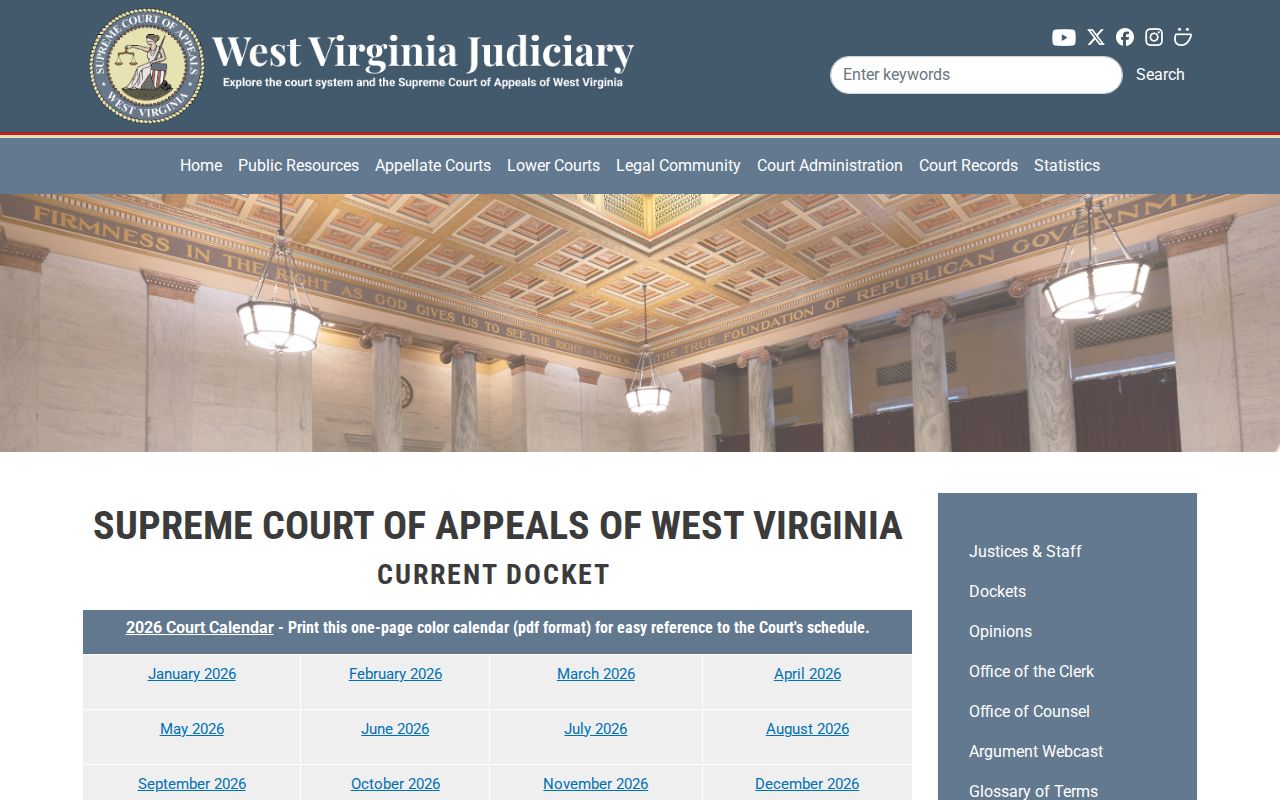
The Supreme Court of Appeals and the Intermediate Court of Appeals each publish a current docket page for West Virginia appellate arguments. These cover appellate matters only. County trials, motions, and daily settings never appear there. Skip them for anything at the trial-court level.
The SCA page filters by Docket Year and Argument Type. Its Search box is capped at 128 characters. Its documented argument options are Any, Rule 19, Rule 20, Order List, Admissions, and Baker’s Cup. The official SCA current docket carries those appellate listings. It holds nothing from a lower-court hearing calendar.
The same filters work on the West Virginia ICA page. They return appellate docket entries, not a county trial calendar.
There, the tools are YEAR, Argument Type, and SEARCH. SEARCH is limited to 128 characters, with pagination for browsing. Argument options run to Any, Rule 19, Rule 20, and Order List. The official ICA current docket is a second appellate-only route, and it lists no county trial hearings.
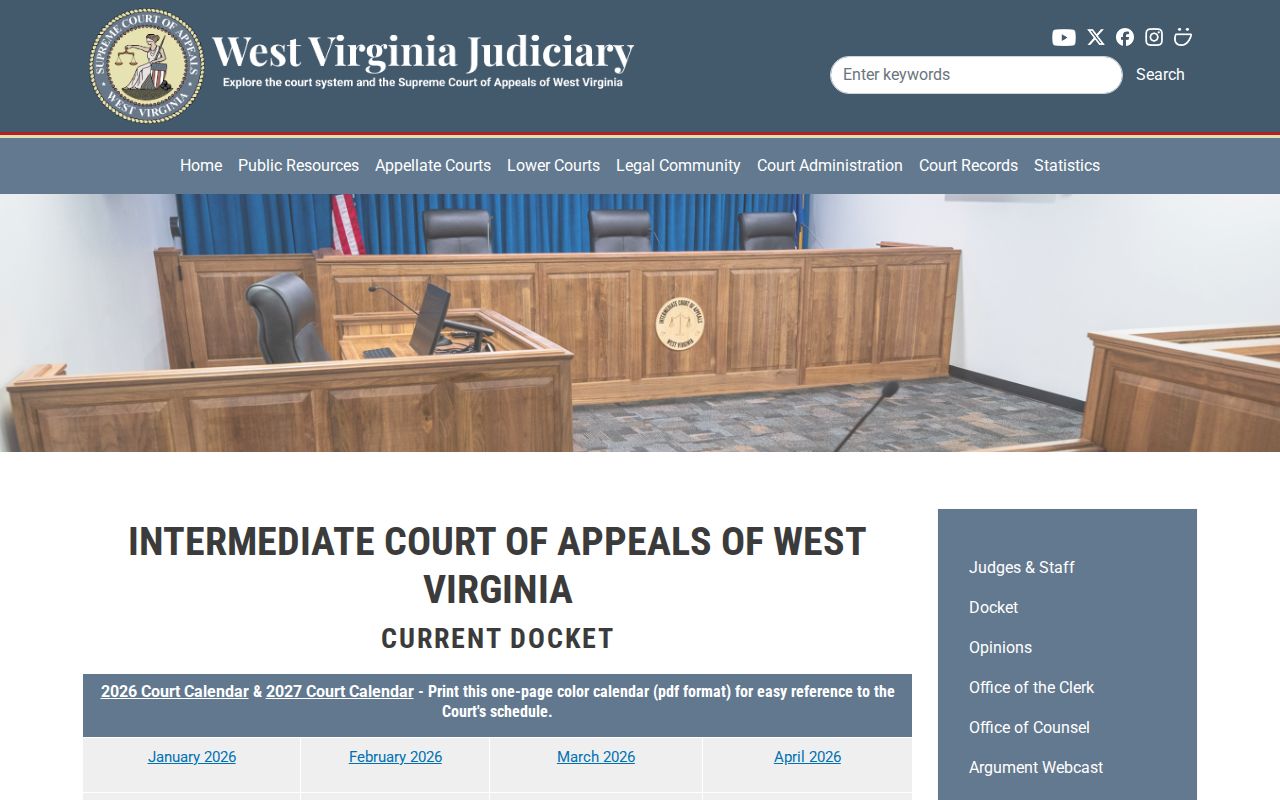
The ICA rows and pagination help you spot listed appellate arguments. Even so, they form no complete searchable register of every appeal, and they offer no county trial-calendar search.
Resets, Continuances, and Cancellations
In West Virginia, a continuance means the court has approved moving a proceeding to a later date. A reset is simply a changed setting. It may follow a continuance, a scheduling action by the court, or some other recorded reason. A motion asking for a new date is just a request. It changes nothing on its own.
Check for the court’s order or a later notice. Then confirm the new date on the docket or with the clerk. A calendar can lag behind an order. The docket may list the motion, the ruling, and the new notice as separate entries. Compare dates and document titles rather than reading “motion filed” as “continuance granted.”
If the online record shows one date and a recent notice shows another, call the clerk or assigned court promptly and ask which setting controls. Ask which setting controls. A canceled setting deserves the same care. Verify it against a later notice or order. West Virginia posts no single statewide reset or cancellation label on any fixed interval.
West Virginia Traffic Court Date Rules
West Virginia Magistrate traffic citations follow set timing rules for contested trials and continuance requests. Under Rule 11 of the Magistrate Criminal Procedure Rules, a noncustody party contesting a citation must get trial notice by first-class mail at least six weeks before trial. Rule 12 generally requires a written continuance motion filed and served at least 10 days before the first trial date. Good cause can excuse the delay. These rules govern the citation process itself. They do not create any statewide trial calendar.
- Trial notice
- For a noncustody contested citation trial, Rule 11 sets a minimum six-week mailed-notice period.
- Continuance motion
- Under Rule 12, a written motion is generally due at least 10 days before the first trial date, unless good cause supports an exception.
- New setting
- A new date follows court action. The motion alone is not proof that the original date moved.
Read the current notice together with any later order. Dates matter here.
If the date is close or the notice reads unclearly, confirm with the Magistrate Court Clerk or court staff for the county where the citation was filed.
Note: A citation’s response date, a contested-trial notice, and a later continuance are distinct events, each with its own timing rules.
West Virginia Court Date Confirmation Path
Is a West Virginia online entry missing or stale? The local court is your practical confirmation point. The docket may show a clerk-entered notice or event. Court staff, though, can check the live case-management view and the assigned courtroom. Who you call depends on the court. The matter may sit in Circuit, Family, Magistrate, or municipal court. The statewide Judiciary county court directory lists each local court and clerk contact.
No single statewide public lower-court calendar coordinator exists in West Virginia, and the Judiciary publishes no global remote-hearing or closure policy. Weather changes, remote appearance instructions, or a room assignment all come from the notice issued by the court handling the case. Confirm those details with that court’s staff. A county site may post a local list. Read each notice as applying only to its named court and date.
What To Do If You Miss a Setting
Think you missed a West Virginia setting? Contact the clerk or court handling the case right away. Give the county, the court, and the case number if you know it. Ask for the current case status. Ask for the next date. Also request a copy or location of any order or notice that changed the setting. When the court is unclear, the county directory points you to the right office.
If a court date may have passed:
Contact the relevant Circuit Clerk, Magistrate Court Clerk, or court office in West Virginia promptly. Ask staff to confirm the current setting and explain how to obtain the latest docket entry or order. Do not rely on an older calendar listing when the court has issued a later notice.
For a West Virginia municipal matter, contact the municipality named on the citation or notice. Keep the court’s confirmation with your case papers so the date, the place, and any later instruction can be checked against the official record.
Note: On a municipal citation, the municipality named on the West Virginia notice controls the local court route.